Notice: Undefined variable: errorEmailAddress in /home/ifa5ihag8ocn/domains/a-i-inc.com/html/classes/ErrorHandler.php on line 54
Notice: Undefined index: name in /home/ifa5ihag8ocn/domains/a-i-inc.com/html/globalConfig.php on line 24
HOME
Home
Visit Our Partners
|
Home > Technology & Applications > Chemical Sensor InformationChemical Sensor InformationA micro-plasma is used to excite gases entering Caviton's detectors (patents pending). The excited gas molecules give off characteristic light, or emission, that can be used for their identification. The high-energy density plasma breaks down chemicals into atomic and diatomic constituents, with well characterized spectral profiles. This allows for simultaneous, multiple chemical identification of gases entering the detector. These detection systems are ideal for gaseous exhaust emissions and process control applications. Additional systems incorporate gas chromatography for the identification of trace and multiple chemical species in complex mixtures. The systems have no moving parts, are rugged, portable, and provide the detailed chemical identification information of expensive, bulky, fragile laboratory scale analytical instruments. The sensors have been operated at temperatures of 1100°C during metals detection tests, and function in high-humidity environments (water vapor content is one factor that these sensors monitor). Data from the sensor can be sent straight to a computer via a USB cable, or transmitted wirelessly to the hand-held monitoring and logging device. Below is a picture of a prototype sensor. Most of the electronics in this picture are related to the AC power supply. The sensor itself is the small rectangular white box that's been written on with a black marker.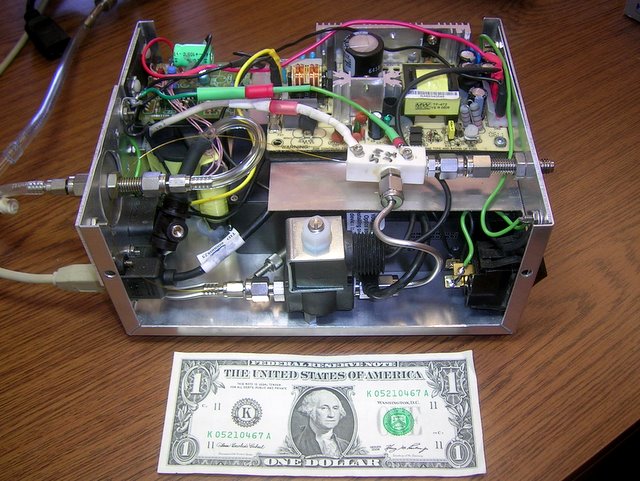
|
Sign-up to receive news about our embedded sensor solutions. |
|
Embedded Sensor Solutions |